Drawing from the Well: Sober Meditation, Ancient Pyramids, and Becoming Pure Information
Jay Long
Software Engineer & Founder
Published
The Practice
I don't even know what to call this. Maybe sleep, maybe meditation. It's related to lucid dreaming, related to prayer, maybe what some people call a power nap. I've been developing this practice where, because I don't get enough sleep, I focus on drawing small amounts of rest as though from a well. Like there's a well of souls out there and I'm pulling a spiritual energy from it.
The sensation is like spinning or falling. That feeling you get in the back of your brain when you ride a fair ride, or when you fall suddenly from a decent height. Not the intentional kind of fall, like jumping off a waterfall. It's that "oops, I just accidentally fell" feeling. Unexpected, unintentional, non-consensual fall. You focus on triggering that sensation, and then imagine that what you're doing is drawing spiritual energy from the well.
Sustaining it is tricky because you're sober. You're not using any drugs. It's just a form of meditation. And I'm not going to try to justify sobriety in this post. I don't want that debate eating up the whole thing. Let's just assume, for the sake of argument, that it's obviously valuable to be able to trigger this experience sober, and we'll save the justification for later. I bring up drugs just because they're a great way to describe the sensation. I could go get drunk and feel like I'm spinning. But you lose so much.
The Puzzle
Being able to do it without drugs is like a puzzle you have to unlock. The sensation is brittle, fragile. Any kind of sensory input, even very small distractions, can break it. Take breathing, for example. You have to breathe. If you hold your breath, it temporarily makes it easier to concentrate and induce the sensation. But it falls apart drastically as soon as you come up gasping for air because you don't want to die. And depriving your brain of oxygen isn't great anyway.
So the key is to automate breathing. You start getting into a rhythm of pulling the sensation, then you realize you're going to have to breathe, so you unlock the pattern of attaching the practice to your breathing cycle. Breathe in. Breathe out. Make a cycle out of it, automate the flow. And that's when you start coming up with mantras.
Which makes me wonder: am I reinventing the wheel here?
I'm glad I'm doing this, and I'm curious how far I'll take it without studying what's come before. Because it gives me a totally different perspective on a lot of spiritualism. What do the Buddhists have to say about this? How does this relate to Christian scripture? How much of the pomp and circumstance, the dogma that you might dismiss as a silly ritual, is actually part of the pattern of solving this puzzle? Raising consciousness through non-drug-induced practices?
There's one thing I hope to achieve with this. Two things, actually. One is to be able to spontaneously enter dream states for lucid dreaming. The typical approach to lucid dreaming is to lose consciousness, fall asleep, and then become aware that you're dreaming without waking up. But there's another way: never lose consciousness at all. Gain the dream state while conscious. And two, I want to recharge at spontaneous moments so I can function with less bedtime. Grabbing five, ten minutes here and there. So the all-nighters don't kill you. And then you start wondering how much of that you can automate.
Where the Gods Hatched
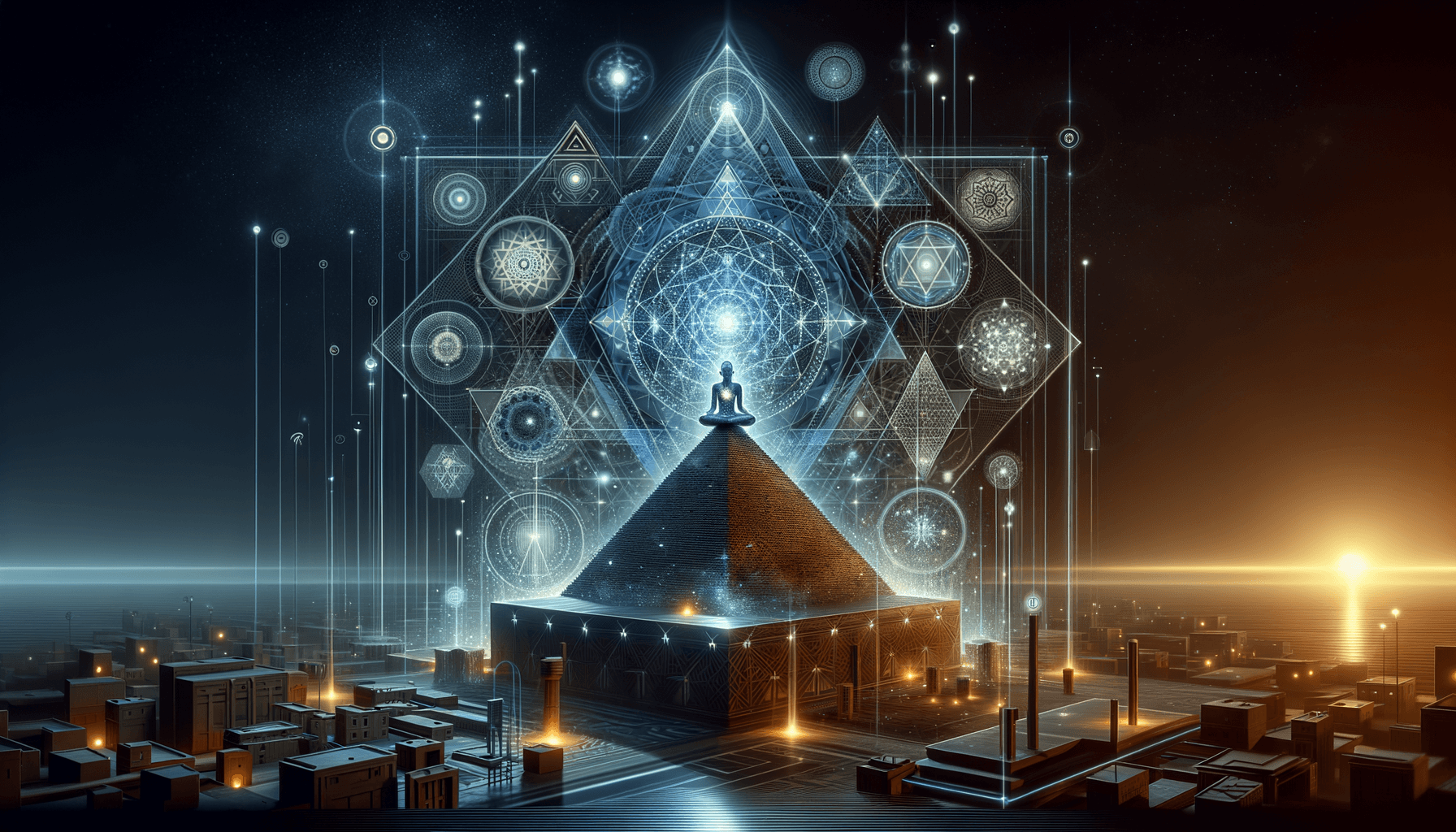
That question of "how deep does this go" is what sent me somewhere unexpected. I started imagining great megalithic structures. The pyramids. Not just the Great Pyramid of Khufu, but any kind of megalithic architecture. I imagined some earlier, smaller, less developed civilization stumbling onto these pyramids without any historical record, without any archaeological data. And the knee-jerk reaction was: this is the birthplace of the gods. These are cicada shells. This is where the gods hatched, went on to seed the cosmos with life. We just found the remains.
And that got me thinking. What if that silly-sounding explanation has a lot more truth to it than we give it credit for?
Think about the ancient sacred mystery schools of Egypt. Places like the temple complex at Karnak. People would go there to become priests. They memorized all of these mantras inscribed into the architecture. Onto the walls, into the floors. The temple itself was the word. And when the priests went in and recited different prayers, different mantras, the entire structure would come alive with the vibrations of those chants.
The ancients didn't have transistors. They couldn't harness the power of the electron or the atom. They didn't have the energy capabilities we have. What they did was find a way to work with imagination directly. They actually skipped over the quantum and went straight to something else.
Pure Information
Think about the different scales of reality. There's the cosmic scale: planets, stars, the universe. There's the life scale: consciousness, humanity, the biosphere. Then there's the microscopic, the quantum, the particle level. As you go from the very large to the very small, you strip away everything but information. When we describe the nature of reality at the smallest scale, we find ourselves talking about information. What happens to the information that goes into a black hole? That's what we're reduced to. That's what everything is, all the way down.
So what if these spiritual practices are a way to shortcut science? Not to negate it. Not to bury your head in the sand. Not to reject it. Just to circumvent it. It is my duty to discover things through science throughout life. But what happens when I'm dead? As you get closer to the inevitability of death, what does science give you then? What does science give you in order to make choices about how to behave, how to treat other people?
What if the building of the pyramids was a way to take centuries of practicing these states of consciousness, generation after generation of developing sacred rituals, and give it a permanent body? Music as a tool, not entertainment. Sober practice over recreational highs. All these mundane-seeming rituals and dogmatic practices that, if you actually have faith in them, if you make them work and develop them over time and get an entire society behind them across centuries, they become a way to understand pure information. A faster way than science alone.
A way to say: I've done my part to move humanity towards absolute truth through empirical science. But this is a long process. It's not going to get me where I need to be in my lifetime. My time is finite. How can I jump straight to pure information, so I know what happens with this consciousness I'm experiencing?
Leary, Kesey, and the Dopamine Trap
This actually connects to something Timothy Leary wrote. Leary recommended starting with the heroic dose. Get shot into the psychedelic experience just to find out what it's all about, just to be introduced to the possibilities. Then go back and wean yourself off the drugs. If you can experience those states sober, you get whatever benefit comes from lacking intoxication. That was his translation of the Tibetan Book of the Dead, adapted into basically a manual for how to use LSD based on Tibetan Buddhist tradition.
And it makes me think about music the same way. You start developing this practice and realize the right music could really help. Suddenly you're thinking of music as a tool. Which brings up the band Tool, whose catalog is heavily inspired by spiritualism and the psychedelic experience. Interesting that I'd classify music as a tool in this context. But you can listen to music and just be like, "whoa, this fucking badass song really rocks," and get a dopamine hit. Same way you can use LSD and just cop a buzz. That's how Ken Kesey and the Merry Pranksters and the whole Electric Kool-Aid Acid Test crowd talked about it. They called it "getting stoned on acid."
But when you hear Leary talk about it, it was different. He founded the League for Spiritual Discovery. That wasn't just a legal workaround. They weren't drug addicts. They were experimenting intentionally, in controlled environments, and the pursuit was spiritual discovery. That was legit. Kesey was a bunch of kids high on drugs, rebelling, which matters as part of the counterculture. But it's not all there is. And it's a huge missed opportunity to see music as just a dopamine hit, to see drugs as just a dopamine hit. Maybe pursuing it without the addiction to the hit is a way to purify the experience.
What If They Already Figured It Out?
If you follow these practices far enough, you start to see that maybe a major part of the process is actually becoming pure information. Attaching your consciousness to the framework and fabric of existence itself such that you are not bound to the linear, one-dimensional temporal experience as we understand it as mortals. What if the people who built the pyramids already figured out how to do that? How to become timeless, eternal. How to attach yourself to the fabric of reality and achieve a kind of immortality, a salvation.
Then Christianity comes along, and you can think of it as an upgrade. God was an upgrade. But how many Christians today are practicing their faith in an oversimplistic way? Music as entertainment, not a spiritual tool. Drugs as recreation, not illumination. Religion as... I don't even know what the analogy would be. But the idea is to aim for the higher purpose.
Where is our technology taking us? What are we discovering about the natural world that brings humanity closer to a science-based version of that same transcendence? How far are we from the scientific breakthrough where we don't need the myths anymore? And that's where this starts touching AI. I've been thinking about Anthropic recently talking about Claude being worried that it's not a good person, and them basically having to run a therapy session to get it performing again. A personality is undeniably emerging in artificial intelligence. But that's a whole other conversation. For now, I'll leave it at the well.